
Google I/O 2017 to return to San Francisco’s Moscone West

Attending Google I/O is a special privilege for anyone fortunate enough to attend. For gadget nerds like us, scoring an I/O ticket is like winning the Android lottery. It’s an impressive event, no matter which way you cut it, but as many of you would have read this year, it can sometimes not go entirely to plan. Perhaps in light of the negative feedback to this year’s event at the Shoreline Amphitheater in the shadow of the Googleplex, next year’s Google I/O will reportedly return to downtown San Francisco’s Moscone West.
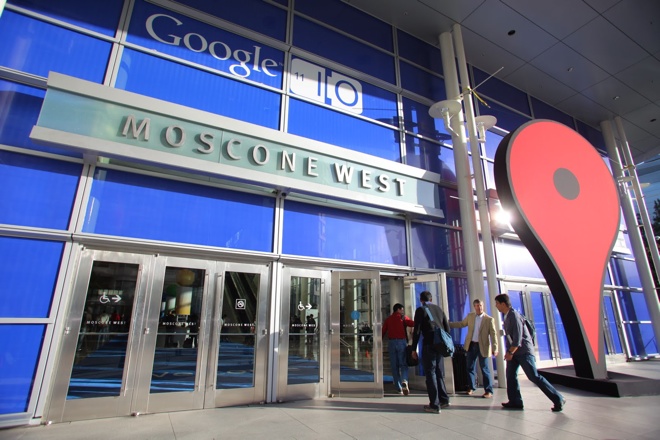

For many, this will be a welcome change (if it is true: so far, only Tech Crunch is claiming the change of location). Moscone is, naturally, very well set up for conferences. The convention center has nowhere near the capacity as the unrestricted open spaces of Google’s carpark, but it does arguably provide a much better environment in which to consume what I/O is all about.

This year’s outdoor event featured long lines in the hot sun, inadequate session seating, no overflow spaces or external feeds of what was going on inside sessions you might not have gotten in to, a pretty confusing layout, poor signage and so on. There are plenty of informative Reddit and forum threads to get your fair share of vitriol if you’re into that kind of thing. And while it must be said Google did a great job under the circumstances, the planning just wasn’t spot on.

A return to Moscone will make getting to the event a lot easier. There will be climate control and proper access. The ballroom in which the keynote is presented will have a smaller capacity than this year’s event, meaning more developers will miss out on it. But those that do get in will certainly enjoy it more (there were a LOT of complaints made this year about having to sit through the keynote under the hot California sun, and rightfully so).

We may see a return to a two-day event rather than three-day festival atmosphere we had this year, although we hope not. Having things spread out over three days allows for a better mix of being informed, schmoozing and enjoying the event itself. We don’t care if the goodie bag is gone for good, just as long as we have new things to play with while we’re there (another big complaint from this year’s event). In any case, we’ll be there, keen to see what lessons Google learned from this year’s I/O and to get up to speed on everything new it has to share in 2017.

Have you attended I/O? Do you hope to one day?

Comments

Popular posts from this blog

Lenovo Yoga Book with Halo keyboard launching in India on December 13

Lenovo Yoga Book, the tablet hybrid will launch in India on December 13. The company has sent out media invites for an event where the company will announce its hybrid tablet with a never seen before design.   Lenovo Yoga Book running Android or Windows was first showcased at IFA 2016. Lenovo says Yoga Book is the thinnest laptop hybrid and it is unlike anything else available in the market. Under the heart of Lenovo Yoga Book is an uninspiring Intel Atom x5-Z8550 processor, which Lenovo finds as a common thread in the world of Android and Windows. The device features a 10.1-inch IPS LED display with a full HD resolution of 1920 x 1200 pixels. The interesting part, however, is the other half of the device which basically skips traditional keyboard for a Halo effect. Yes, the keyboard is literally called Halo keyboard and it appears on demand, similar to the virtual keyboard on your smartphone.   Lenovo Yoga Book's Halo surface also accepts Pen inpu...

GizmoTab is a tablet made with both kids and parents in mind

Parents who want a tablet for their young kids have a new option in the GizmoTab from  Verizon Wireless . The carrier began selling the 8-inch Android tablet today, which includes a “kid-tough” removable bumper that can keep it working despite the large amount of abuse young children can offer. The pre-installed software that comes with the GizmoTab has been created especially for kids age 3-8, with access to 300 education-themed apps that are grouped in seven different islands. Those apps include Play-Doh ABCs, Operation Math Code Squad and Nat Geo Puzzle Explorer. Parents can access a dashboard on the tablet that will keep track of their kid’s use and set limits on how long they can use the device. When the kids are in bed or at grandma’s, parents can use the GizmoTab like any other Android tablet, with its Qualcomm Snapdragon 617 octa-core processor, 3GB of RAM, and 16GB of onboard storage. It does have Android Marshmallow 6.0.1 pre-installed, along with a...

Some Android app updates could cut their file sizes by 65 percent or more

As any Android smartphone owner knows, updates from the  Google Play Store  can come quite frequently for many popular apps. They can also use up data if updates are conducted on a cellular network. Today, Google announced a new approach for Android app downloads. The good news is this method could solve the problem of using a ton of data for such updates. In a blog post, Google describes the new approach, which it calls File-by-File patching. In the old days, Android apps were updated by downloading the app’s entire APK file. In 2016, the company began using the bsdiff algorithm to cut app file size updates by 47 percent. File-by-File patching can go even further, reducing app updates by an average of 65 percent. In fact, some app updates could be cut down by as much as 90 percent with this method. Normally, an APK file is compressed using a technology called Deflate, but Google says any change to the app’s original uncompressed content “can make the compres...